Configured, not custom-built.
Elevate is configured at the client level by people who run programs, not by a services team writing code. That is the whole reason a mid-market program can go live on a platform that also runs enterprise networks.
A methodology built to compress the timeline.
Our implementation approach blends industry best practices with rapid-launch software configuration. The platform ships with sensible defaults; the work of an implementation is deciding where your program differs, not building it from nothing.
Timelines vary with scope, supplier count and integration depth. What we have consistently found is that the variable driving the schedule is rarely the software.
- Empowered, accessible client resources
- Organizational readiness
- Collaborative communication and change management
- Engaged stakeholders across procurement, HR and hiring
- A branded program with a compelling value proposition
The tools your admins
actually use.
Program configuration lives in the product. Rates, fees, approval routing, business-unit hierarchy and supplier tiers are all set by your team through the admin tools: no release, no ticket, no consultant.
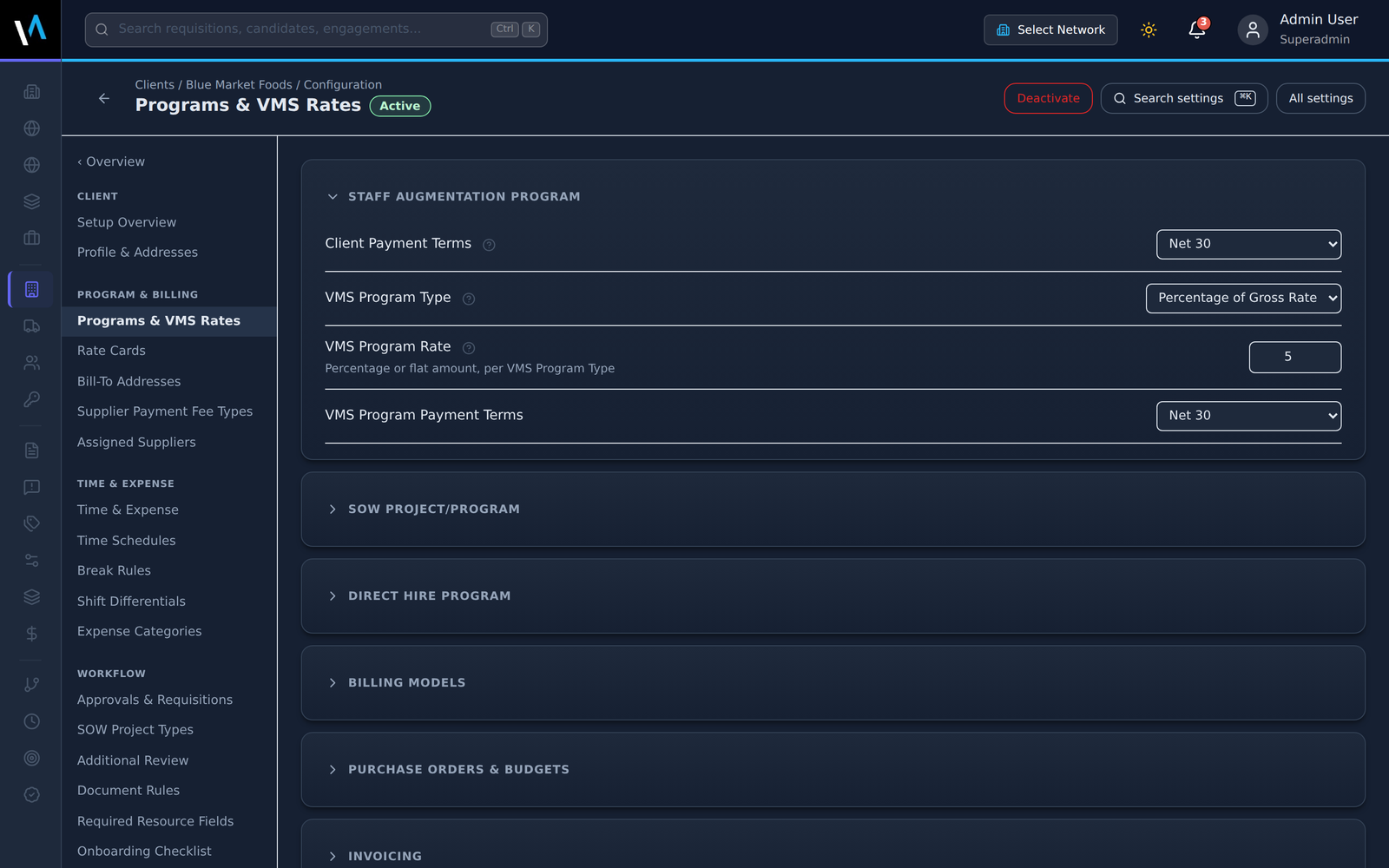
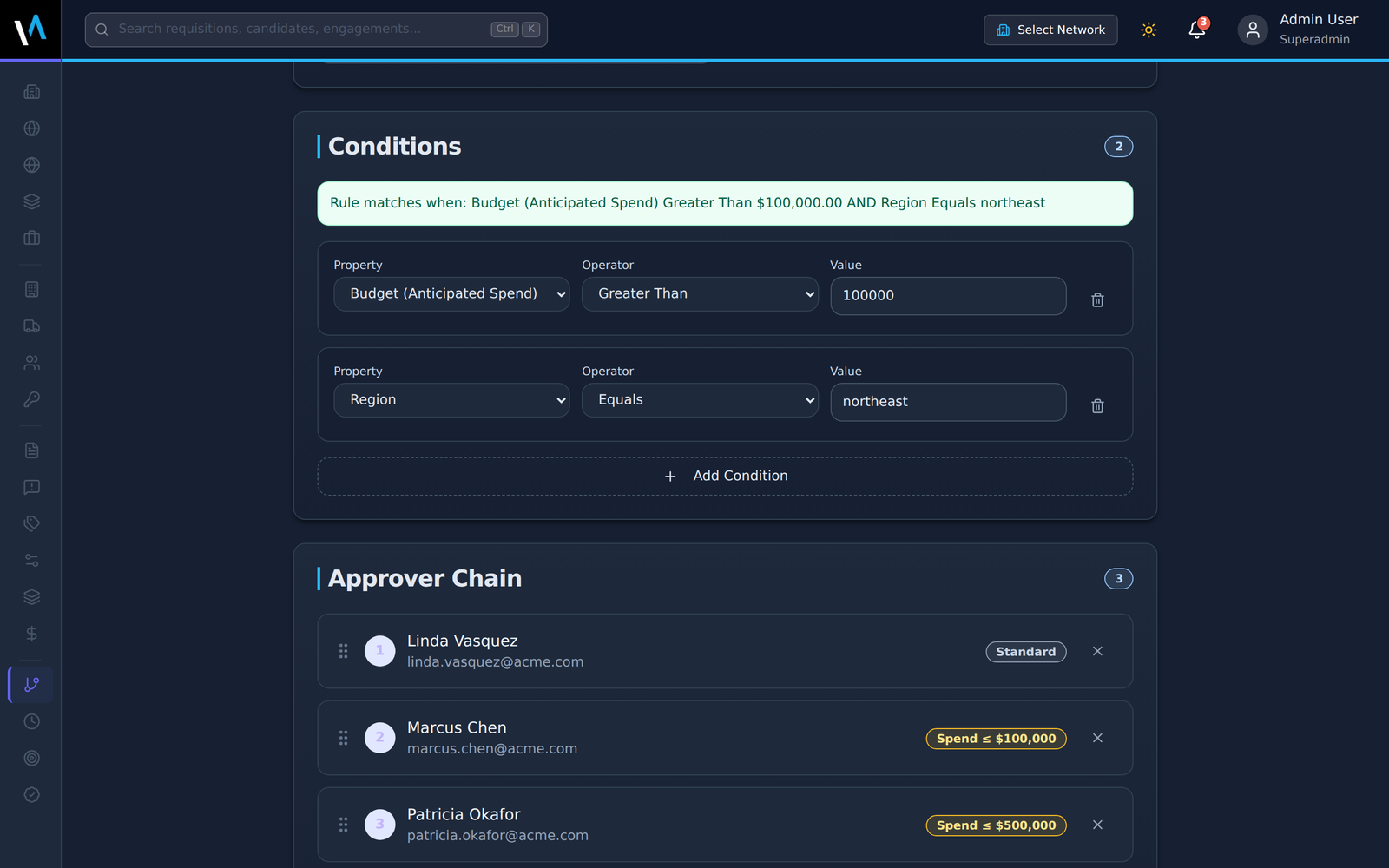
Want to see these driven live against your own program design? Book a working session rather than a demo.
One platform,
many programs.
A network holds one or more clients: a holding company with several operating companies, or an MSP running distinct customer programs. Configuration happens at the client level, so each program gets its own workflows without its own instance.
- Separate business-unit hierarchy configurable per client
- New customers stood up without new infrastructure
- New features reach every customer at once
- Access restricted by network, client or dataset, with SSO available
The part most vendors
stop talking about.
Issue & case management
An ITIL-based case management system documents platform issues and tracks them to resolution. Tickets route automatically to the responsible team, and every stakeholder on an open issue stays updated.
A roadmap you can see
The product roadmap is a shared source of truth: vision, direction, priorities and progress over time, so you know what is coming before it ships rather than after.
Customers shape it
Input comes through quarterly planning cycles, the customer success portal and one-on-one conversations, then moves into an agile development process rather than a yearly release.
Program design
Rate structures, fee model, approval thresholds, business-unit hierarchy and supplier tiers: decided with your team and configured as they are decided.
Configuration & integration
The program is built in the admin tools. Standard integrations to HRIS, ERP and payroll are connected in parallel; see Integrations for the mechanics.
Supplier onboarding
Suppliers are invited, tiered and trained. This is usually the phase where a schedule slips, and it is a function of supplier responsiveness more than software.
UAT & launch
Your team runs its own scenarios against the configured program. Changes at this stage are configuration changes, not development tickets.
Adoption & iteration
Quarterly planning cycles, roadmap input, and a case management system for anything that breaks.
Bring us your program design.
The most useful first conversation is not a demo. It is an hour with your rate structure, your approval rules and your supplier list on the table.